FTV: Music Consumption
The most recent ‘next big thing’ in the record industry isn’t actually that big even though it is causing a big stir. It is a 4 inch 33 ? vinyl record designed to hold a music track up to four minutes long on each side. Not surprisingly, it is called ‘Tiny Vinyl’. What surprises me the most is the music industry has once again found a way to market music by offering yet another new format. After reading a rundown of how people’s modes of music consumption have changed over the last century, I thought it might be fun to take a look back. Let’s see if you recognize where your music consumption began and where you may land in today’s recorded music market trends. My thanks to AARP – The Magazine for the historical data.
We won’t go all the way back to the invention of the phonograph as I am pretty sure none of us experienced the wax cylinder origins pioneered by Thomas Edison (known as the Edison Recorder). Vinyl records as most of us know them came about in the early 20th century. While I have never purchased a 78 rpm record, I remember my folks having a few in the storage area of the first RCA radio / record player cabinet that I remember. The RCA cabinet hung around the house until 1966 when it was replaced by a new stereo Magnivox combo radio / record player. The new unit had an extension speaker in the basement so I could play my drums along with records. The old unit got moved out to our camp along with the few 78s it still had in storage. The Magnivox was late 1960s state of the art, but I kind of missed the hum of the tubes warming up on the old RCA model.
Did the newer unit even have a 78 rpm speed setting? It didn’t matter to me because my collection started with 45 rpm singles and quickly grew to include 33 ? LPs (‘long players’, as albums were called). Try as they might, each new music format that emerged over the last fifty years could not make LPs obsolete. With the sudden resurgent interest in vinyl, LPs are now selling for record prices (pun intended) and in ever increasing numbers. The Recording Industry Association of America (RIAA) tells us that 44 million vinyl albums were sold in 2024. Out of curiosity, we will have to see if Todd at the WOAS-FM West Coast Bureau will tally his growing collection for us (which now lines two walls of his music room). Maybe I should accuse him of buying half of the 2024 albums sold . . . no, I am kidding (but his record collection is impressive).
The 1940s saw the development of reel-to-reel tapes. The bulk machines used for recording and playback belied how fragile the tape medium used seemed when compared to vinyl. The first on the market were expensive and used primarily in the recording industry. R-t-R machines eventually became available for home recording but commercial reel-to-reel music releases from outlets like Columbia House were limited. According to AARP Magazine, “The format was thought to be extinct, but reemerged last fall with rereleased classic titles by Yes and T.Rex.” I first encountered the reel-to-reel recording in 1967 or 1968 when high school friend Nick Gorski borrowed his fathers Sony machine. We set about recording our own versions of Firesign Theater bits for our own amusement.
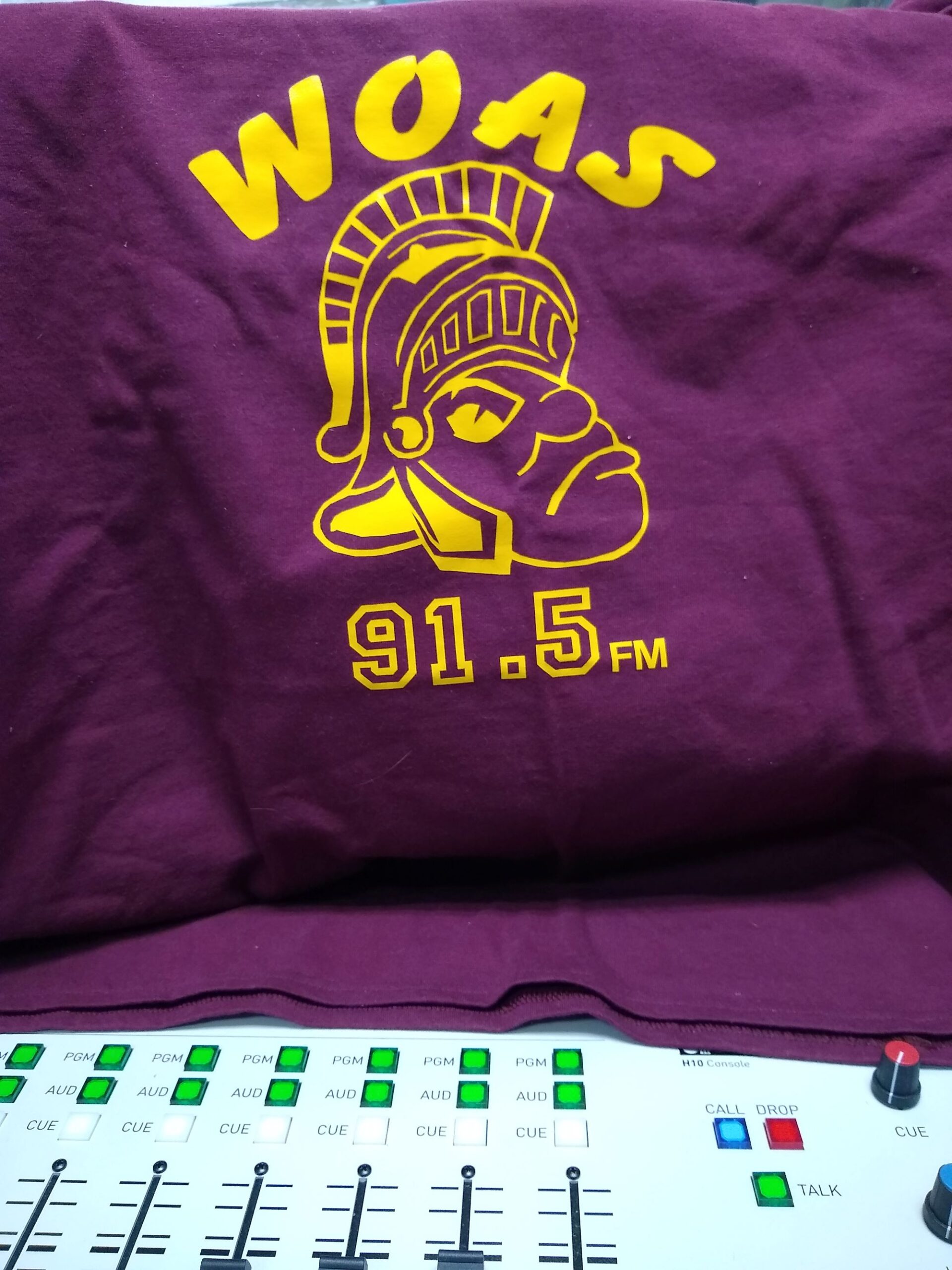
When WOAS-FM went on the air in December of 1978, there were two reel-to-reel players mounted in our equipment bay. There were boxes of very large tape reels in the studio that allowed the station to play pre-recorded syndicated programming when there were no live DJs on the air. These machines were taken out of service when the station was first remodeled in the late 1980s. Fifteen years ago, we were given four old, very heavy R-t-R machines that were no longer being used by the local health department. With no room to store them and no programming utility for us, we tried to give them away at one of the Christmas Walk events in the pre-COVID but had no takers. They eventually were sent away via an e-waste collection.
The arrival of 8-track tapes in the mid-1960s announced the arrival of the next new thing in music. Radio stations jumped on this bandwagon because it was possible to have PSAs and advertisements on a series of 8-track tapes. Grab a cassette, shove it into the ‘cart machine’ and hit play. The only drawback? The cart machines and tape racks took up quite a bit of room. If one attended an event DJed by WUPY’s Kenny Lee back in the day, you couldn’t help but notice he had a lot of his music being toted around in this format. After former Country Music DJ legend Dr. Bruce Straton moved from Ontonagon to Brownsville, Texas, he sent WOAS two cart machines as a donation. Dr. Bruce explained that his new station had moved on from them and thought they would be of use to us. I thanked him but didn’t have the heart to tell him that we had disposed of ours a couple of years earlier as well.
My entry into the world of 8-track tapes came via my buddy Mitch. He had a nice player in his car and when he upgraded to a newer player, he gifted me his. I first installed it in my old Chevy sedan and later transferred it to my trusty S-10 pickup truck. The road music was handy when I spent two summers driving back and forth to band jobs from my summer job washing dishes at the Huron Mountain Club near Big Bay. With the windows down and Deep Purple or Black Sabbath tunes on earweld volume, nothing was better for keeping me awake driving down the road at 2 a.m.. When I later upgraded to a newer player, I was still toting around a box of 8-tracks in my truck. I noticed the cook at the Baraga A&W had a whole pile of 8-tracks in the window so I asked the carhop to see if he would like to buy them all for five bucks. She came back and said, “Only if they aren’t stolen,” to which I replied, “Nope, they are all mine…but I want my tape box back.” Maybe I should have kept them. Who knew my future wife would have her own 8-track player in her college hifi set up and that it would also end up finding a home at our camp?
While 8-tracks had a couple of glitches in them (like the ‘clunk’ they made when changing tracks and the label’s habit of adding a repeated track on some units to save hearing empty space), they were popular. They would give way to another type of cassette tape and today are pretty much relegated to hobbyists. Both Mitch and I had replaced our 8-tracks in our vehicles with cassette players. Both of us had also acquired portable boombox player/recorders that made it possible to transfer vinyl albums to tape. This meant we could not only take our record collections on the road, but we could swap albums to convert to tape.
Naturally, the record companies jumped on this trend and began releasing new music on both vinyl and cassettes. Interestingly enough, they also sold a lot of older music when people began replacing some of their albums with the new fangled cassette tapes. When 8-tracks and then cassettes became the rage, the first thing I noticed was the packaging. For me, buying albums included a lot of window shopping and once home, one had to thoroughly inspect the artwork and track information on the album covers. Shrink the packaging down to the size of a cassette tape and it deflated a big part of the record buying experience.
Though they were first developed in 1963, the mass introduction of the Sony Walkman in 1979 caused a surge in cassette sales. The many Walkman imitators that came on the market also fueled more cassette sales for the next couple of decades. By 2011, however, the brand had been rebranded as ‘digital flash memory players’ more or less killing cassette production and sales. With the higher prices being charged in the current resurgence of vinyl record sales, many artists have gone back to also releasing new music on cassette as a low-cost way for fans to own a physical copy of an LP. When Mike Bennett did the first major renovations of WOAS-FM in the mid 1980s, he included new cassette players for the DJs to spin tunes.
The only downside to using cassettes in the radio station was finding a track for one particular song in mid-tape. Dropping a needle in the right place on a vinyl record is a DJ skill as old as turntables themselves. Finding the right cut on a tape took a lot more trial and error. On the plus side, my entry into WOAS-FM came when I began recording the original From the Vaults shows on cassette tapes. Mike liked them because the student DJs would run them between their shows and if someone didn’t show up, the programming would just loop itself every 3 hours. The same held true between the end of the school day and the next evening DJ’s show. Eventually, the number of FTV tapes amounted to over 1,400 hours of programming but they were used for so long, the oldest tapes began to lose the will to live. What remains of the whole collection currently resides in a drawer in the studio. None-the-less, we still have a couple of cassette players in the studio which our current crop of DJs look at the same way we probably looked at the wind-up record players we saw at the local historical museum we visited in our youth.
Time marched on and when Philips and Sony introduced CDs in 1982, it ignited a different set of revolutions. Yes, the new format required a new generation of players (and later player /
recorders). The packaging was larger than cassette cases, so there was a slight improvement in the art of album art. Size and portability issues were on par with the cassettes but they were more durable than the fragile tapes which were beginning to wear out. Goodwill and St. Vinnies stores found themselves inundated with the albums that CD converts were discarding in droves as many music fans replaced their record collections with CDs. Very early in this audio seachange, perhaps the seeds of the new vinyl revolution were sowed: some took exception to the sound quality of CDs versus vinyl.
Audiophiles complained that the manner in which music was reproduced on CDs was inferior to what could be heard on vinyl. CD supporters claimed their sound quality was superior to vinyl because there were no pops, crackles, hums, or skips to be heard. Some vinyl heads went too far poiningt out that there were frequencies at both the high and low end of the spectrum that were missing from CD tracks. Most people consumed their music from radio and TV or in environments where it had to compete with background noise (bars, cars, and so forth). There were strong opinions on both sides of the argument but the people in the middle ground (like me) said, “I can’t hear any difference.” When confronted with this debate, I choose to stay out of the line of fire because there is no ‘let’s agree to disagree’ stance to this discussion.
The RIAA’s numbers put 2024’s CD sales at 33 million units. They are not as popular as they once were, but they remain the big dog in the hunt in terms of album sales. In our increasingly digital world, only time will tell how CDs will fare in the future. Big box stores seem to have reduced their CD inventories to a bare minimum but they have brought back at least some vinyl record racks. Boutique music stores like The House of Records that Todd and I visit when I am at the WOAS-FM WCB continue a healthy business in all the old audio formats.
Do not ask me to weigh in to anything about the current digital revolution involving A.I. because I really have not gone down that rabbit hole yet. I am still trying to catch up with what happened when MP3s and WAV files began to supplant music that was being physically distributed in CD form. Artists and labels, both big name and independent, have been terrific at sending us music to air on WOAS-FM. Syndicated programs like Beale Street Caravan, Woodsongs Old Time Radio Hour, and Dr. Duck’s Rx for Guitar have also been very generous in providing shows on CD for us to air. The kicker here, however, became production and mailing costs.
The end result has been predictable: the majority of new releases are now offered to us as digital downloads. In some cases, they will add a caveat saying, “If you would like a physical copy, please let us know.” Even a big time label like Alligator Records went this route but not before gently reminding stations, “yes, we can still send CDs but it would help our bottom line a lot if we could have you download them.” When downloading tracks and albums became more popular in the 1990s, we got our feet wet and found ourselves burning CDs of these files to make them fit our station format. Most of the music we have played live for the last 30 years has been from CDs. Multiple well CD players gave us the option of programming blocks of music several hours long. This practice replaced the pre-recorded shows on cassette we previously used for this purpose.
By the time the 2010s rolled around, streaming became the top source of revenue for the U.S. record industry. Services like Spotify allow one to play music directly on devices without needing to download them. WOAS-FM is fully equipped to broadcast music via streaming, but we still train our new DJs how to construct their shows with CD sourced music first. Once they demonstrate they can operate the broadcast board, change to different music tracks, and do announcements between songs, then we allow them to start incorporating streaming into their shows. To them, it may seem old school, but we have found that a good number of them will stick with CDs. In that we have a vast collection of music in many genres, DJs are able to mine them and learn about music that predates them by many years.
The one thing we need to caution the new DJs about is the nature of how things work in a non-commercial educational station. We are not allowed to do any kind of commercial endorsements and the fact that many of the music sources they stream drop adds into the middle of the stream. We also caution them about using their computer or phone to simply run their personal playlist on the air. Broadcasting music must involve interacting with their audience and this sometimes gets lost when a DJ punches play and then zones out. We stream audio and video of our on the air broadcasts and they are reminded that there is nothing more boring than listening to or viewing our video stream to see nothing going on. The top (or worse, back of) a DJs head who is either scrolling on their device or having a conversation with another person while the music is playing is simply not good radio.
Certainly station automation and the looming A.I. takeover of everything has and/or will change the radio broadcast landscape. Time and technology wait for no one, but with that said, nothing says we can’t continue to use older music consumption paradigms as well. Technology isn’t an issue – I am no luddite – but we are still going to teach new DJs radio the old fashioned way. When the A.I. overlords implode, WOAS-FM DJs will be ready to fill the gap.
Top Piece Video: I will post The Doors for this one – for years and years I told people that the first LP I bought was their eponymous album. The truth be told, that was my second album. The first was The Monkee’s self titled debut which followed their first hit single, Last Train to Clarksville. I do believe this is the performance that got The Doors banned from The Ed Sullivan Show for singing the word ‘higher’ – look at the smirk on Robbie Krieger’s face after the first time Morrison sings it – bad boys, weren’t they!